
Article written and published by
Dr. S.Mithra BSMS.,M.D Regd No:3149
The Silent Organ That Holds the Key
It began with something small.
A little thirst.
A little tiredness after meals.
Raman, a 52-year-old school teacher, never imagined that a tiny organ hidden deep inside his abdomen—the pancreas—was struggling.
Inside every human body lives an elegant biochemical story. At the center of that story is insulin, a hormone produced by specialized beta cells in the pancreas. Its job is simple yet profound.
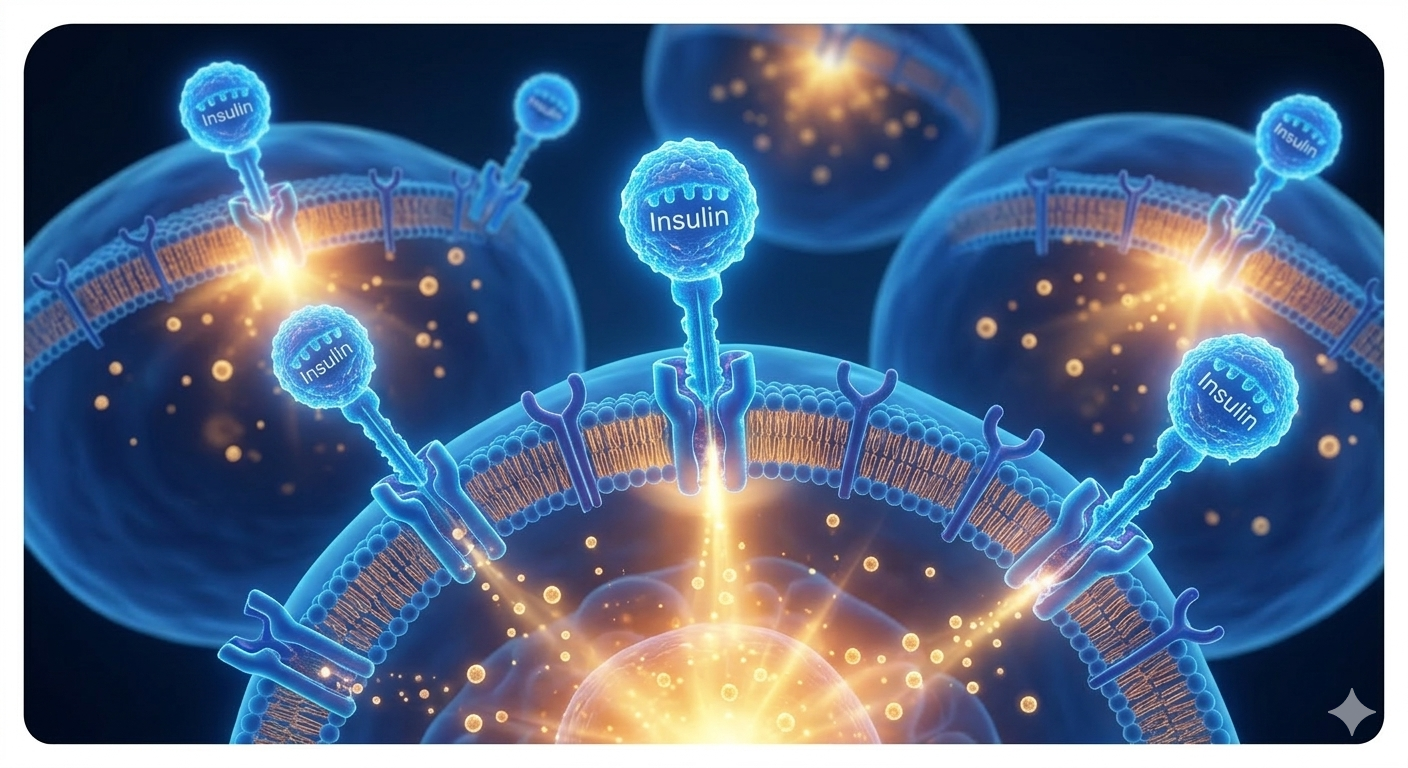
Insulin acts like a key.
After we eat, glucose enters the bloodstream. But glucose cannot enter the body’s cells on its own. The cells remain closed doors.
Insulin unlocks those doors.
When insulin binds to receptors on the cell surface, glucose is allowed to enter the cell and become energy. Muscles move. The brain thinks. The heart beats.
When glucose levels rise after a meal, the pancreas releases more insulin. When the sugar is absorbed into cells, blood glucose levels return to normal.
But when this system fails, something dangerous begins.
Glucose remains trapped in the bloodstream.
This condition is called hyperglycemia—the biochemical foundation of diabetes.
Without insulin working properly, the body begins to starve even in the presence of excess sugar. Cells cannot access their fuel. Over time, the excess glucose silently damages the nerves, eyes, kidneys, and blood vessels.
The body still has energy demands.
So it turns to fat.
Fat breakdown releases molecules called ketones, and if uncontrolled, they can lead to a dangerous state known as ketoacidosis.
Raman’s blood report showed exactly this early metabolic chaos.
His pancreas was tired.
His insulin was weak.
But the real question was deeper.
Could the pancreas regain its strength?
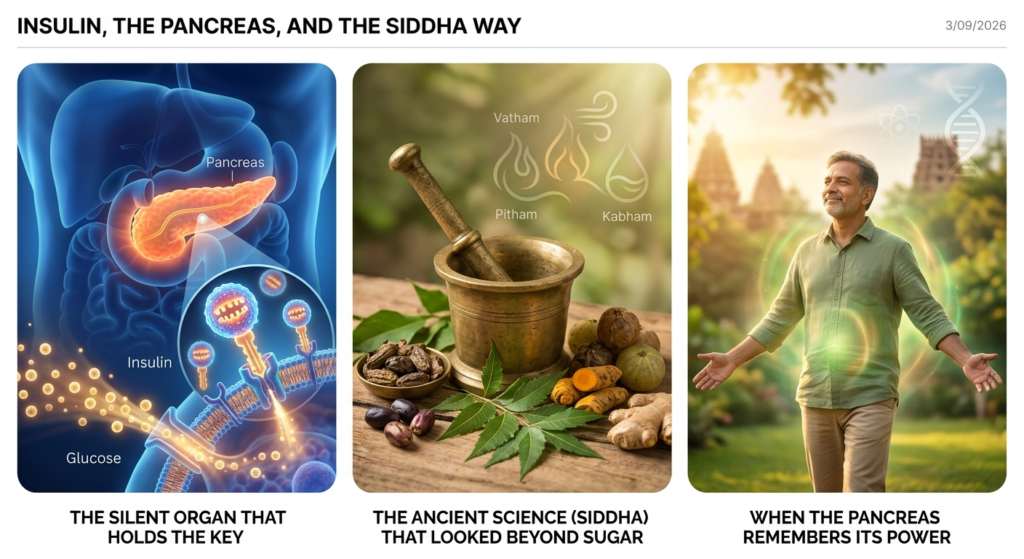
The Ancient Science(siddha) That Looked Beyond Sugar
Modern medicine looked only at Raman’s numbers.
But the Siddha physician looked at Raman himself.
In Siddha medicine, the body is not seen as isolated organs but as a dynamic balance of forces—the three vital humors:
Vatham, Pitham, and Kabham.
When digestion, metabolism, and tissue transformation are disturbed, the pancreas—known functionally within the metabolic framework—begins to lose its regulatory harmony.
The Siddha doctor explained something remarkable.
“Insulin is not just a hormone,” he said.
“It is the messenger of metabolic intelligence.”
According to modern physiology, insulin performs many essential functions beyond controlling glucose:
It stimulates the liver to convert glucose into glycogen, storing energy for later use.
It supports muscle repair by helping amino acids enter cells.
It regulates lipid metabolism, controlling how fats are stored and broken down.
It even influences brain functions related to learning and memory.
But when metabolic imbalance persists, the pancreas becomes overworked.
Siddha medicine approaches this problem differently.
Instead of only forcing the body to reduce sugar levels, Siddha therapies aim to:
• Restore digestive fire and metabolic transformation
• Improve tissue nutrition (Udal Thathukkal)
• Reduce metabolic inflammation
• Support pancreatic vitality
Through carefully designed herbal formulations, dietary regulation, and detoxification approaches, Siddha medicine attempts to revive the body’s own regulatory intelligence.
Certain Siddha herbal preparations have historically been used to support metabolic balance and pancreatic function. These medicines are believed to enhance insulin sensitivity and improve cellular glucose uptake.
For Raman, the treatment was not just medicine.
It was a complete metabolic reset.
Diet was adjusted.
Digestion was strengthened.
Herbal formulations were introduced to restore systemic balance.
Weeks passed.
Something began to change.
When the Pancreas Remembers Its Power
Three months later, Raman returned for follow-up tests.
His fasting glucose had dropped significantly.
But something more important had changed.
His body no longer felt exhausted after meals.
His cells were finally receiving energy again.
From a scientific perspective, this improvement suggested something powerful: better insulin efficiency and improved glucose utilization.
When insulin begins to function properly again, several beneficial metabolic events occur simultaneously:
Glucose moves efficiently into cells.
The liver stores energy as glycogen rather than allowing glucose to accumulate in blood.
Fat metabolism stabilizes.
Protein synthesis improves, aiding tissue repair.
Electrolyte balance and cellular function normalize.
In essence, the body remembers how to regulate itself.
This is where Siddha medicine offers a unique perspective.
Instead of fighting the body, it attempts to restore the body’s forgotten intelligence.
The pancreas is not merely an organ that secretes insulin.
It is part of a larger metabolic orchestra.
When harmony is restored across digestion, tissues, and metabolic pathways, insulin begins to work not as a forced intervention—but as a natural expression of balance.
For Raman, the lesson was profound.
Health was never about suppressing numbers.
It was about restoring the body’s inner wisdom.
And sometimes, the path forward lies not only in modern discoveries—but also in ancient sciences that understood the body’s rhythm long before insulin was ever discovered.
References
- Smith Y. Insulin’s Role in the Human Body. News Medical Life Sciences.
Hall JE. Guyton and Hall Textbook of Medical Physiology. 13th Edition. - American Diabetes Association. Pathophysiology of Diabetes Mellitus.
- Saltiel AR, Kahn CR. Insulin signalling and the regulation of glucose metabolism. Nature. 2001.