
Published by Dr. Pazhaniyappan BSMS,
In today’s medical landscape, the image of treatment is often reduced to a syringe. A quick injection. A rapid effect. A visible intervention. For many patients, especially those with chronic diseases like Diabetes Mellitus, injections become symbols of “serious treatment.” The stronger the disease, the stronger the needle — this belief has quietly shaped modern expectations.
Are we managing disease — or restoring health?
Tamil traditional medicine, particularly the Siddha system, offers a perspective rooted in thousands of years of clinical wisdom. It does not deny acute care. But it asks a deeper question: what created the imbalance in the first place?
Historical Siddha Foundations: Healing Begins with Balance
Siddha literature has long described systemic diseases resembling modern diabetes under the term Neerizhivu or Madhumegam.
In Yugi Vaithiya Cinthamani 800, it is described:

“மேகம் என்பது உடம்பின் தாது சீர்குலைவால் உண்டாகும்”
Megam arises from derangement of the body constituents.
This emphasizes that the disease originates from disturbance in Udal Thathukkal 🧠 Essence (Saram) – Energy, Nourishment
🩸 Blood (Senner) – Circulation, Vitality
💪 Flesh (Oon) – Muscle Strength
🫕 Fat (Kozhuppu) – Fat Storage
🦴 Bone (Enbu) – Bone Strength
🧬 Marrow (Moolai) – Nerve Strength
🧫 Semen (Sukkilam) – Reproductive Power
Each tissue is illustrated and imbalance of Mukkutram (Vatha, Pitha, Kabha).
Similarly, Theraiyar Vaagadam explains that improper diet, lifestyle excess, and weakened digestive fire (Agni) lead to systemic metabolic disorders affecting urine, blood, and vitality.
These texts did not describe “high sugar” alone.
They described a constitutional collapse.
The focus was always on correcting terrain, not merely reducing one measurable parameter.
The Injection Era: Life-Saving, Yet Not Without Risk
There is no ethical debate regarding insulin in Type 1 diabetes or acute hyperglycemic crises — it saves lives.
However, globally reported data highlight concerns related to injectable therapies in chronic care:
- Severe hypoglycemia from insulin therapy has been associated with increased cardiovascular mortality in several large-scale trials.
- Studies such as the ACCORD trial (Action to Control Cardiovascular Risk in Diabetes) observed higher mortality in aggressively intensified insulin-treated groups compared to standard therapy.
- Hypoglycemic episodes significantly increase risk of arrhythmias, neurological damage, and sudden cardiac death.
- Recurrent insulin-induced hypoglycemia may impair autonomic regulation and cognitive function.
These findings do not condemn insulin. They remind us that powerful interventions require careful balance.
Injections regulate glucose rapidly.
But they do not inherently:
- Restore digestive function
- Reduce systemic inflammation
- Correct lipid metabolism
- Detoxify metabolic waste
- Reverse lifestyle-induced imbalance
Control is achieved.
Root imbalance may persist.
Siddha’s Holistic Approach: Constitutional Correction
Tamil traditional medicine approaches Neerizhivu through multi-dimensional correction:
1. Agni Restoration (Digestive Fire)
Metabolism begins in the gut. Herbal decoctions stimulate digestion, improve absorption, and prevent toxin formation.
2. Mukkutram Regulation
By balancing Vatha, Pitha, and Kabha, systemic harmony is restored rather than forcing biochemical suppression.
3. Udal Thathukkal Protection
Therapy strengthens:
- Saaram (nutritive plasma)
- Senneer (blood quality)
- Kozhuppu (lipid metabolism)
- Enbu and Moolai (structural and neurological integrity)
4. Detoxification
Internal herbal formulations and external therapies remove accumulated metabolic waste and inflammatory mediators.
5. Pathiyam (Therapeutic Diet)
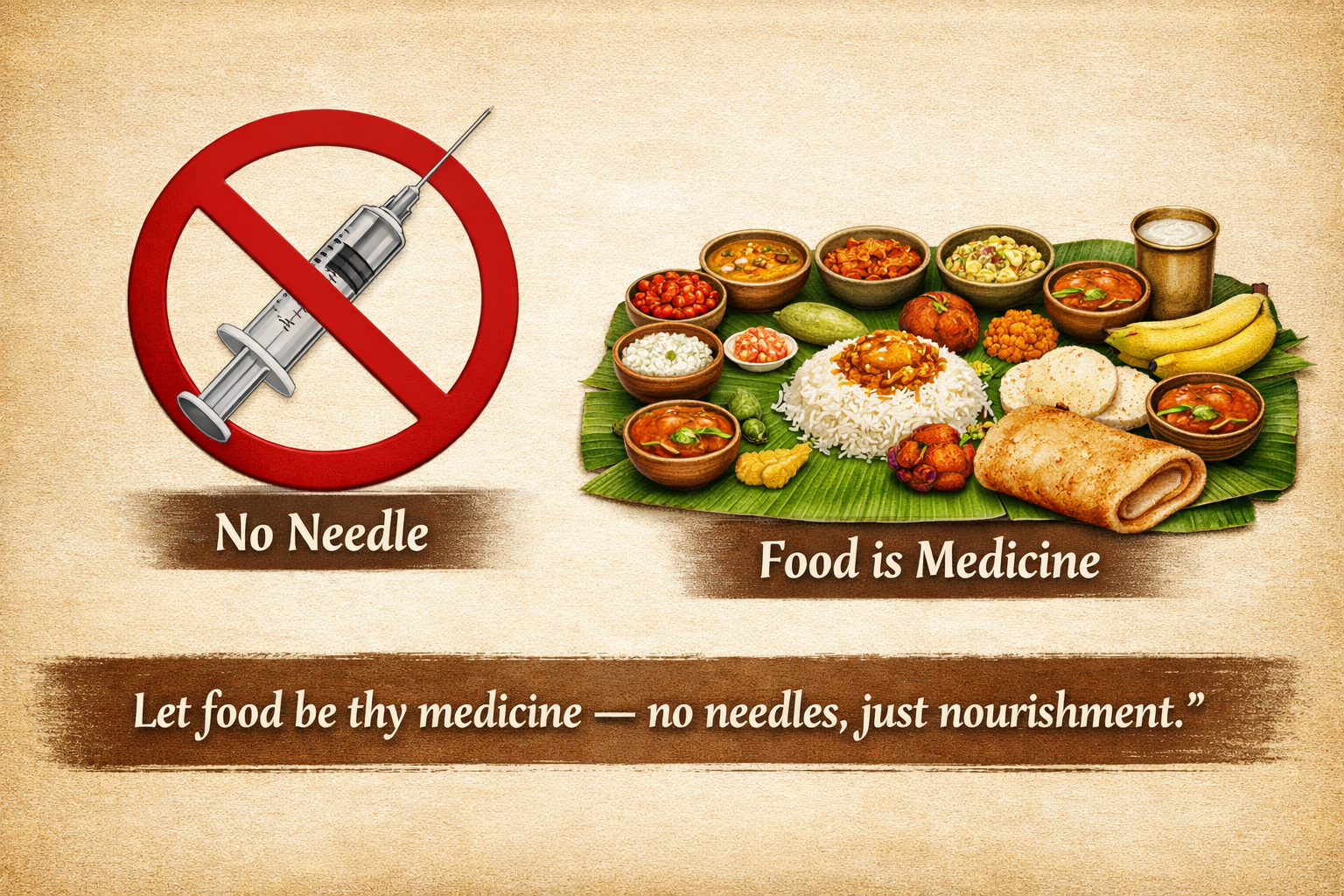
Food becomes medicine. Strict dietary discipline prevents recurrence and stabilizes glucose naturally.
6. Psychological Stabilization
Siddha emphasizes calmness, sleep correction, and emotional balance — factors strongly linked to glycemic control.
This is not a single-point intervention.
It is a systems-based strategy.
Safety and Sustainability
One of the strengths of properly administered Siddha herbal therapy is gradual metabolic modulation without sudden glycemic crashes. The aim is not rapid suppression but stable correction.
Where injections may produce abrupt biochemical shifts, Siddha therapy encourages progressive adaptation. The body learns to regulate rather than being externally forced.
This distinction is critical in chronic diseases.
Integrative Wisdom, Not Opposition
This is not an argument against modern medicine.
Emergency care demands rapid intervention. Severe hyperglycemia, diabetic ketoacidosis, and life-threatening infections require insulin and critical care support.
However, for long-term metabolic imbalance, relying solely on injectable management without constitutional correction may leave systemic dysfunction unresolved.
Tamil traditional medicine reminds us:
Disease begins in imbalance.
Healing begins in restoration.
The syringe may silence a symptom.
But holistic correction rebuilds resilience.
In the words echoed across Siddha tradition:
Health is not the absence of sugar in blood.
It is the harmony of body constituents, balanced humors, stable digestion, and disciplined living.
When treatment addresses all these dimensions, healing becomes deeper — and often more enduring.
True medicine is not only powerful.
It is wise.