
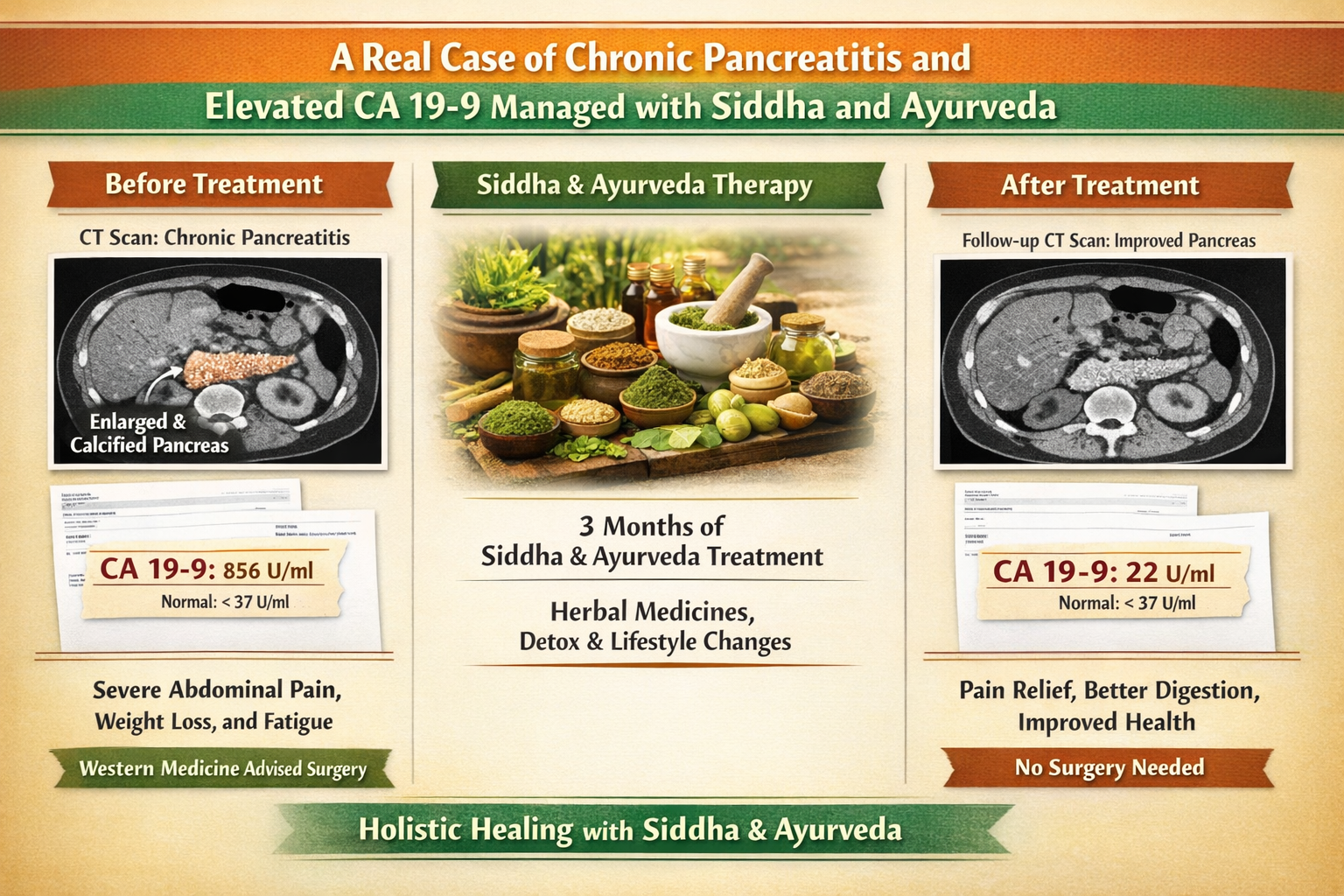
A Real Case of Chronic Pancreatitis and Elevated CA 19-9 Managed with Siddha and Ayurveda
Published by Dr. Pazhaniyappan BSMS

Key Takeaways
- Chronic pancreatitis increases long-term cancer risk.
- CA 19-9 is a critical monitoring marker in pancreatic disease.
- Traditional Siddha and Ayurveda focus on correcting metabolic imbalance.
- In this case, CA 19-9 reduced from 49.00 EU/ml to 6.75 EU/ml following structured traditional care.
What Chronic Pancreatitis Means
She is a mother of two children. A homemaker. The quiet strength of her family. Her day begins before sunrise — preparing meals, sending children to school, managing the household, caring for everyone else. But for more than twenty years, she has been living with something invisible.
Chronic pancreatitis is not just abdominal pain. It is cooking for your children when nausea makes you turn away from food. It is pretending to be strong when weakness drains your body. It is sleepless nights because of abdominal discomfort, and waking up tired but still carrying on.
The pancreas sits silently behind the stomach, performing two vital roles — aiding digestion and regulating blood sugar. When chronic inflammation continues for years, digestion weakens, metabolism slows, and the body’s internal balance begins to break down.
Medical evidence shows that chronic pancreatic inflammation increases the risk of pancreatic cancer by 2.7 to 16.5 times. For someone already fighting daily discomfort, that knowledge adds another layer of emotional burden.
Living with chronic pancreatitis is not only a medical condition. It is a constant physical struggle — and an emotional one — especially for a mother who wants nothing more than to stay strong for her children.
Why CA 19-9 Matters
CA 19-9 is a biomarker used in pancreatic disease surveillance.
Values above 37 U/mL are considered abnormal.
Values above 300 U/mL strongly suggest malignancy.
An elevated result does not automatically mean cancer. But it signals stress, inflammation, or abnormal cellular activity within the pancreatic or biliary system.
For patients already living with chronic pancreatitis, a raised CA 19-9 often brings anxiety.

The Patient’s Story
A 42-year-old female with more than twenty years of chronic pancreatitis presented with recurrent abdominal pain, nausea, anorexia, abdominal distension, weakness, pedal edema, and disturbed sleep.

Her laboratory findings showed:
| Feature | First Report | Second Report |
| Date | 31/12/2024 | 10/01/2026 |
| CA 19-9 | 49.00 EU/ml | 6.75 EU/ml |
| Reference Range | < 37 EU/ml | < 35 EU/ml |
| Status | Elevated | Normal |
The first report showed 49.00 EU/ml — clearly above the normal limit. This suggested ongoing inflammatory stress.
Radiological evaluation did not show malignancy. Still, the elevation was clinically significant in the context of chronic inflammation.
The treatment goal was not simply to reduce a number on paper. It was to arrest inflammatory progression, restore digestive strength, improve assimilation, and prevent long-term structural degeneration.
Understanding It Through Siddha and Ayurveda
In Ayurveda, chronic pancreatic inflammation is associated with disturbance of Pitta and Vata dosha, impaired digestive fire (Agnimandya), and accumulation of Ama (metabolic toxins).
In Siddha medicine, the condition reflects imbalance in Mukkutram — Vatham, Pitham, and Kabam — particularly aggravated Azhal affecting digestive and metabolic pathways.
Both systems share one principle:
Persistent inflammation weakens tissues over time.
Instead of isolating the pancreas, treatment focuses on restoring internal metabolic equilibrium. Digestive correction, reduction of inflammatory burden, and tissue nourishment form the foundation of therapy.
A previously published case in the International Journal of Ayurveda and Pharma Research reported a similar reduction in CA 19-9 following Ayurvedic intervention in pancreatitis, suggesting a reproducible therapeutic pattern.

What Changed After Treatment
Following structured Siddha and Ayurvedic management with dietary regulation and lifestyle correction, the patient reported:
Improved appetite.
Reduction in nausea.
Less abdominal distension.
Better sleep.
Decreased weakness.
Reduction in pedal edema.
Most importantly, CA 19-9 declined from 49.00 EU/ml to 6.75 EU/ml.
This level is well within the healthy reference range.
The reduction suggests modulation of inflammatory activity rather than spontaneous normalization. Medical literature indicates that CA 19-9 typically declines after effective intervention.


Why This Case Matters
Chronic pancreatitis is difficult. It is long-term. It is exhausting. And it carries risk.
Conventional medicine plays a critical role in managing confirmed malignancy through surgery, chemotherapy, and radiation. However, in chronic inflammatory states without cancer, metabolic correction becomes central.
Ayurveda and Siddha do not merely aim to suppress symptoms. They aim to restore balance.
In this case, that restoration was reflected not only in how the patient felt — but in what the laboratory showed.