
By Dr. Palaniyappan | Published on March 27, 2026
A traditional Panchagavya preparation sits quietly in an earthen vessel, fermenting under natural sunlight in a rural Indian setting. What appears simple on the surface is, in reality, a complex biological system—one that ancient practitioners trusted and modern science is only beginning to understand.
Key Takeaways
- Panchagavya combines five cow-derived products with potential multi-system health effects.
- Scientific studies suggest antimicrobial, anti-inflammatory, hepatoprotective, and immunomodulatory properties.
- Components like curd (probiotics), ghee (lipid carriers), and urine (bio-enhancers) show mechanisms aligned with modern science.
- More clinical trials are needed to validate safety, dosage, and therapeutic efficacy.
Understanding Panchagavya in a Modern Scientific Context

In Ayurveda, Panchagavya refers to five substances derived from the cow—milk, curd, ghee, urine, and dung. Traditionally known as Cowpathy, it has been used for conditions ranging from digestive disorders to chronic illnesses.
From a modern perspective, Panchagavya is not a single drug but a multi-component biological system. It interacts simultaneously with the immune system, gut microbiome, metabolic pathways, and cellular repair mechanisms. This multi-layered interaction is what makes it both intriguing and scientifically challenging.
When Conventional Medicine Meets Multi-Component Therapy
Modern medicine often relies on single-target drugs—one molecule, one pathway. But diseases like diabetes, inflammation, and infections are rarely that simple. They involve networks of biological systems.
Panchagavya takes a different route. It combines nutrients, microbes, enzymes, and bioactive compounds, influencing multiple systems at once. This aligns closely with systems biology, where healing is viewed as restoring balance rather than targeting a single defect.
5 Components of Panchagavya and Their Scientific Roles
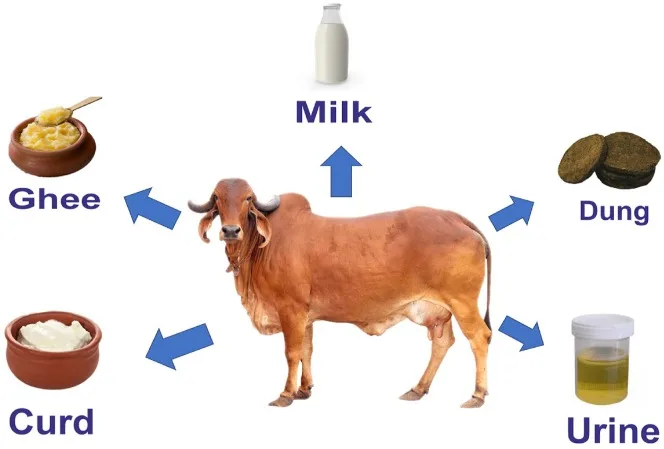
Milk: Nutritional and Cellular Support
Cow milk, particularly A2 type, contains β-casein proteins, essential fatty acids, and vitamins like A, D, and B-complex. Unlike A1 milk, it avoids inflammatory peptides such as BCM-7. Scientifically, it supports tissue growth, enhances immunity, and protects gut lining.
Curd: The Microbiome Regulator
Curd is rich in probiotics like Lactobacillus and Streptococcus. These beneficial microbes improve gut microbiota balance, strengthen immune response, and produce antimicrobial compounds. Modern research increasingly links gut health to brain function, immunity, and metabolism.
Ghee: A Natural Drug Delivery System
Ghee contains omega fatty acids and fat-soluble vitamins. Its unique role lies in enhancing bioavailability—helping the body absorb active compounds more effectively. Studies also point to its anti-inflammatory properties, liver protection, and role in wound healing.
Cow Urine: Bio-Enhancer and Detox Modulator
Cow urine contains urea, minerals, enzymes, and bioactive compounds. Scientific studies, including those supported by Indian research bodies, suggest antimicrobial, antifungal, and immunomodulatory effects. It may also enhance the effectiveness of certain drugs by improving absorption.
Cow Dung: Microbial and Environmental Bioreactor
Rich in beneficial microbes and organic matter, cow dung plays a role in biodegradation, soil fertility, and antimicrobial activity. While its direct human therapeutic use needs more validation, its environmental and indirect health benefits are significant.
What Does Research Say About Panchagavya?
Experimental and preclinical studies have reported a range of biological effects. These include pain relief comparable to standard analgesics, liver protection against toxins, antimicrobial action against pathogens like Salmonella, and faster wound healing. Some studies also suggest memory enhancement and potential anti-cancer activity through molecular pathways.

These outcomes are believed to arise from antioxidant activity, immune regulation, and cellular repair mechanisms—key processes in maintaining overall health.
Beyond Medicine: Role in Agriculture and Environment
Panchagavya is not limited to healthcare. In agriculture, it functions as a bio-fertilizer, enhancing soil microbiome, improving plant growth, and reducing dependency on chemicals. Research shows increased crop yield, better nutrient absorption, and improved soil fertility.
This dual role—supporting both human health and environmental sustainability—makes it a unique integrative system.
Emerging Research: Panchagavya and Nanotechnology
Recent studies have explored its role in synthesizing nanoparticles such as silver and copper. These nanoparticles exhibit antimicrobial and antioxidant properties, opening new possibilities in drug delivery and biomedical applications.
This intersection of ancient formulations with modern nanotechnology reflects a new frontier in integrative science.
Are There Limitations?
Despite promising findings, Panchagavya research is still evolving. Human clinical trials are limited, dosage standardization remains unclear, and safety profiles require large-scale validation.
Programs like SVAROP (Scientific Validation and Research on Panchagavya) aim to bridge this gap by bringing rigorous scientific evaluation to traditional practices.
What This Means for You
Panchagavya represents more than tradition—it represents a shift in how we understand health. Instead of focusing only on isolated chemicals, future healthcare may increasingly consider microbiome balance, multi-system regulation, and natural bio-enhancers.
However, it should always be used under expert guidance, especially in clinical conditions.
Bottom Line
Panchagavya is not merely a cultural relic—it is a complex biological formulation with emerging scientific relevance. With proper validation, it holds potential in integrative medicine, sustainable healthcare, and preventive strategies.
In the quiet fermentation of an earthen pot, there may lie not just tradition—but the blueprint for a more holistic future of healing.