
Dr. Pazhaniyappan BSMS, Dr. Veni BSMS, Dr. Elumalai BSMS
* published by International Journal of Siddha and Ayurveda research Publications, Chennai, Tamilnadu, India
Paper Received Date: 6th January 2026
Paper Acceptance Date: 8th January 2026
Paper Publication Date: 6th February 2026
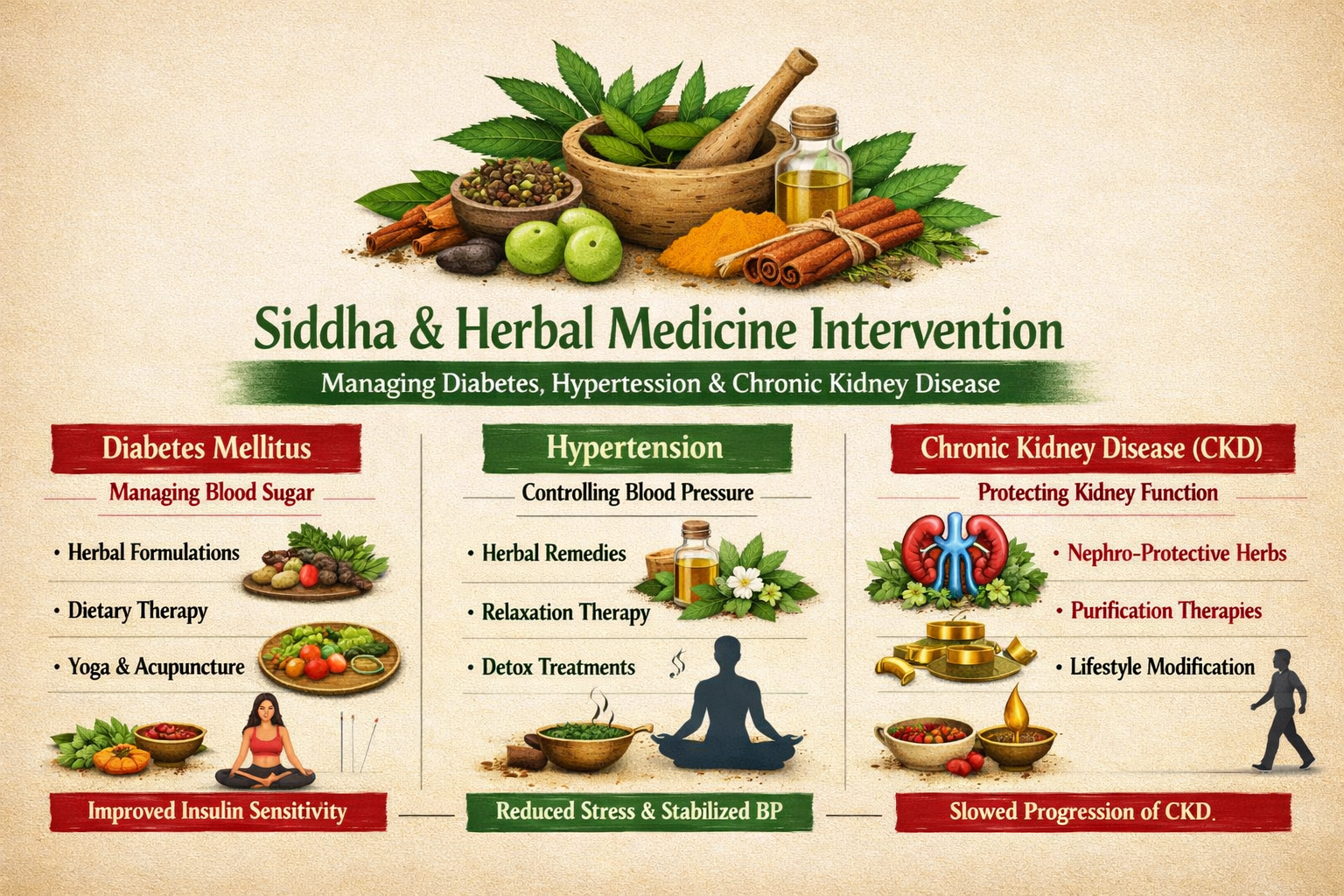
Abstract– Diabetes mellitus (Madhumegam) and Hypertension (Iraippu Noi) are considered major causative factors for Chronic Kidney Disease (Siruneeraga Sirukozhai) . Excessive intake of foods rich in carbohydrates, non-vegetarian foods, and lifestyle imbalance are the causative factors in developing madhumegam according to the Siddha system of medicine. Over the past three decades, the prevalence of diabetes mellitus has increased substantially in India due to rapid socioeconomic development, demographic shifts, and greater susceptibility among Indian people. This case study presents a Siddha-based clinical evaluation and management of a patient suffering from these conditions. The study highlights Siddha diagnostic methods, internal medicines, external therapies, and outcomes, emphasizing holistic management and humoral balance.
Keywords: Diabetes, Chronic kidney disease, siruneeraga sirukozhai, siddha herbal juice
- Introduction
T
his According to estimates, 77 million Indians over the age of 18 have type 2 diabetes, and almost 25 million are prediabetics (with an increased risk of developing the disease shortly) which is expected to rise to over 134 million by 2045(1). Excessive intake of food rich in carbohydrates, fat and non-vegetarian food, excessive indulgence in intercourse, worry, tension, laziness and sedentary work were the causative factors in developing madhumegam according to the Siddha system of medicine. Siddha Yugimuni has classified madhumegam into 20 types based on color, consistency and the smell of urine and other associated bodily symptoms and their complications (2). Siddha treatment focuses on detoxification, humoral correction, rejuvenation, and lifestyle regulation. The following case series presentation sho ws the efficacy of Siddha medicine in the management of madhumegam and its complications.
Patient Details
Sheik Dawood, a 42‑year‑old male, presented to Rathna Siddha Hospital with multiple complaints including frequent urination, episodes of reduced urine output, chronic fatigue (thordar kalaippu), excessive sweating of both palms, and swelling of the bilateral testis. His symptoms suggest a possible underlying genitourinary disorder with associated metabolic or systemic involvement. The urinary disturbances point toward potential renal or urinary tract pathology, while the persistent fatigue and sweating may indicate an endocrine or metabolic imbalance. The scrotal swelling requires further evaluation to rule out conditions such as hydrocele, varicocele, orchitis, or other testicular pathology. Overall, the constellation of symptoms highlights the need for comprehensive diagnostic investigations including urine analysis, renal function tests, blood sugar profile, hormonal studies, and ultrasound imaging to establish a definitive diagnosis and guide appropriate management.
- Siddha observation
Based on the observation, with Urine routine and culture, Renal function tests (serum creatinine, urea, electrolytes) Blood sugar profile (FBS, PPBS, HbA1c) Hormonal profile (thyroid, testosterone if indicated). The patient presents with a constellation of urinary, metabolic, and genitourinary symptoms.
Diagnosis
Diabetes mellitus (Madhumegam)
Hypertension (Iraippu Noi)
Chronic Kidney Disease (Siruneeraga Sirukozhai)
Treatment Plan
Internal Medicines
· Herbal juice- 200Ml (4 times a day)
· Milk+Jil+Phil+siruni+mame+Neeri =60
· Siddha Diagnostic and food Therapeutic Framework
· Power=100gm
Purana+Reena=180(2+2+2)
| Duration ofintervention | Treatment medicine with purpose | Dosage |
| 1-3 days | Thiripalakasayam (gut clensing)Nilavahalchooranam(detoxing the english medicine effect) | 200ml2+2+2 spoons |
| 4-5 two days | xxxxx | xxxx |
| 5-10days | xxxxx | xxx |
| 1month | xxxxxxx | xxxx |
| xxxx |
External Therapies (Siddha External Interventions)
In addition to internal medicines, the patient was administered selected Siddha external therapies, aimed at restoring humoral balance, improving circulation, and facilitating systemic detoxification.
1. Banana Leaf Bath (Vaazhai Ilai Snaanai)
The patient underwent a banana leaf bath, wherein the body was completely covered with fresh banana leaves, followed by controlled exposure to early morning sunlight for 30 minutes daily.
This therapy is traditionally indicated for Vatha–Kapha disorders and is believed to promote cutaneous elimination of toxins, enhance peripheral circulation, and support fluid balance regulation. The mild solar exposure further aids in thermoregulation and metabolic activation, contributing to reduction of edema and stiffness.
2. Meethi Sigichai (Herbal Leaf Poultice Therapy)
Meethi Sigichai was administered using freshly prepared neem (Vembu – Azadirachta indica) leaves and bitter gourd (Paagharkkai – Momordica charantia) leaves.
This external application was selected for its traditional role in reducing inflammatory swelling, pacifying aggravated Kapha, and supporting glycemic and skin-related manifestations. The therapy also aids in clearing obstructed channels (Srotas) and improving local tissue metabolism.
3. Mud Bath Therapy (Mann Snaanai)
A mud bath was administered on alternate days, applying medicated natural mud over the body under controlled conditions.
Mud therapy is traditionally employed for its cooling, absorbent, and anti-inflammatory properties, helping to reduce body heat (Pitham), edema, and musculoskeletal discomfort. It also contributes to relaxation of neuromuscular tissues and enhances overall vitality in chronic systemic conditions.
bhagharkai ilai)
Observation and Outcome
After 1 week of Siddha treatment:
- Reduction in thirst and frequent urination
- Better sleep quality
- Stabilization of urine output
- Overall improvement in quality of life
Discussion
According to Siddha principles, prolonged aggravation dries up body tissues, while Herbal juice balances circulation and excretion. In this patient, untreated, DM and HTN has caused chronic kidney disease. Siddha medicines corrected humoral imbalance, improved neeraga seyal (renal function), and slowed disease progression. External therapies of Mithi sigichai with vembu and bhagarkai helped to pacify the selling in the leg.
Conclusion
This Siddha case study demonstrates that early humoral correction, disciplined internal and external treatment like Herbal juice and individualized Siddha medicines can effectively manage chronic kidney disease. Siddha system offers a holistic, non-invasive approach to improve patient well-being and delay disease complications.
Reference: –
1. Pradeepa R, Mohan V. Epidemiology of type 2 diabetes in India. Indian J Ophthalmol. 2021 Nov;69(11):2932-2938