

In an era, where healthcare is increasingly driven by technology and specialization, there is a growing global realization that healing must extend beyond diagnostics and pharmaceuticals. Chronic diseases, mental stress, and lifestyle disorders have exposed the limitations of symptom-focused medicine, prompting renewed interest in holistic systems that address the human being as an integrated whole. In this global shift toward integrative healthcare, Tamil Nadu emerges not merely as a regional center of traditional medicine, but as a living ecosystem of Siddha and Ayurveda with international relevance.
Unlike many parts of the world where traditional medicine survives as a revived or alternative practice, Siddha and Ayurveda in Tamil Nadu function as continuously practiced, socially embedded medical systems. These traditions are not confined to texts or museums; they exist in households, community clinics, teaching hospitals, and research institutions. This continuity gives Tamil Nadu a unique authenticity that cannot be replicated Siddha medicine, indigenous to Tamil civilization, is grounded in a comprehensive philosophical framework that views health as the balance between Uyir (vital life force), Udal (physical body), and Manam (mind). Disease, in Siddha thought, is not an isolated biological event but a disruption in this triadic harmony influenced by diet, environment, behavior, and mental state. Ayurveda, practiced alongside Siddha in Tamil Nadu, complements this worldview through its emphasis on doshic balance, preventive care, and rejuvenation. Together, these systems offer a multi-layered approach to healing that integrates physiology, psychology, and lifestyle.
What elevates Tamil Nadu to international prominence is not tradition alone, but institutional depth. The state has developed a structured ecosystem that includes government-recognized medical colleges, teaching hospitals, pharmacological units, and regulatory frameworks for Siddha and Ayurveda. This institutional presence enables standardization, clinical documentation, and systematic education while preserving classical knowledge. As a result, traditional medicine in Tamil Nadu operates with both cultural legitimacy and clinical responsibility.
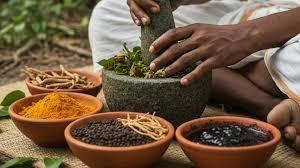
Culturally, Tamil Nadu provides a fertile environment for holistic healing. The state’s climate, biodiversity, dietary traditions, and spiritual practices naturally align with Siddha and Ayurveda principles. Medicinal plants are locally sourced, formulations are prepared within traditional pharmacopeial guidelines, and therapies are delivered in environments conducive to mental and emotional balance. Healing, in this context, is not an isolated clinical event but a culturally sustained process.
As global healthcare systems increasingly explore integrative and preventive approaches, Tamil Nadu stands as a reference point for how traditional medicine can remain relevant in the modern world. Its strength lies not in commercialization or reinvention, but in continuity, depth, and lived practice. Siddha and Ayurveda in Tamil Nadu demonstrate that ancient medical systems, when supported institutionally and practiced authentically, can contribute meaningfully to global health challenges.
In conclusion, Tamil Nadu should be viewed not simply as a destination for traditional treatment, but as a knowledge hub and clinical laboratory for integrative medicine. Its Siddha and Ayurveda traditions offer insights into sustainable healthcare models that prioritize balance, prevention, and human-centered healing. As the world searches for medical systems that are both effective and holistic, Tamil Nadu’s living tradition provides a pathway where ancient wisdom and contemporary relevance converge.