
Dr. Pazhaniyappan, BSMS
Rathna Siddha Hospital, Tamil Nadu, India
For years, diabetes had been described to him in numbers.
Fasting blood sugar.
HbA1c.
Cholesterol.
Nothing more.
At twenty-eight, he believed he had time on his side. But by early 2026, his body was sending signals that could no longer be ignored. Nights had become restless. A dry cough interrupted sleep. Wheezing appeared after sunset. His feet began to swell. Fatigue lingered throughout the day, and anxiety crept into his thoughts. The simplest tasks seemed heavier than before.
He had already been living with Type 2 diabetes and elevated cholesterol levels. He smoked. Alcohol had become part of his lifestyle. Yet what troubled him most wasn’t the diagnosis itself.
It was the feeling that something deeper was happening.
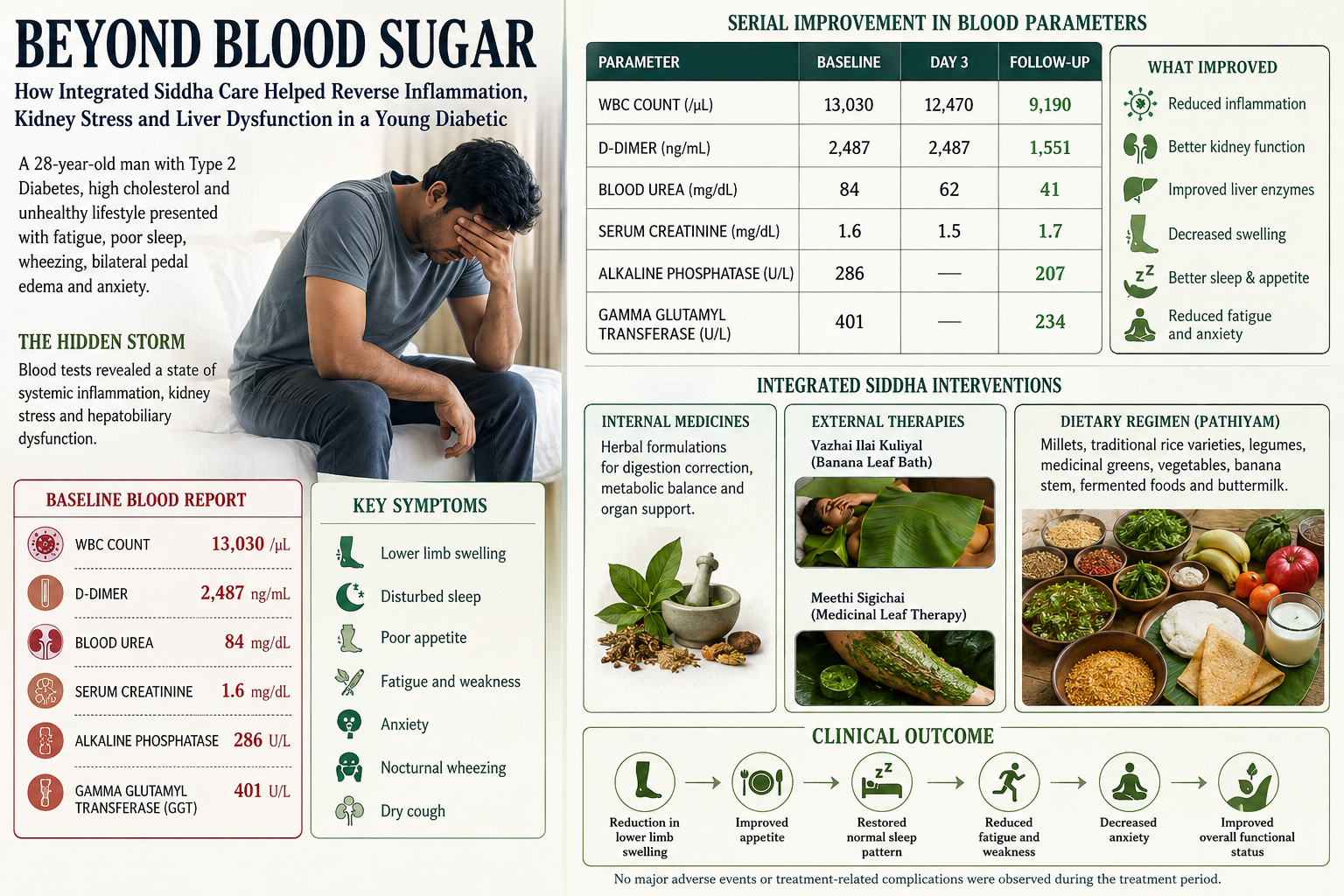
When he finally sought care at Rathna Siddha Hospital in Tamil Nadu, physicians encountered a patient whose symptoms extended far beyond elevated blood glucose. Bilateral pedal edema, disturbed sleep, reduced appetite, persistent fatigue, lower limb swelling, nocturnal wheezing, and anxiety painted the picture of a body under systemic stress.
But it was the blood tests that told the most unsettling story.
His white blood cell count measured 13,030 cells per microliter, indicating active inflammation. D-dimer, a marker increasingly recognized by scientists as reflecting thrombo-inflammatory activity and endothelial dysfunction, had climbed to 2,487 ng/mL. Blood urea reached 84 mg/dL, while serum creatinine stood at 1.6 mg/dL, suggesting that the kidneys were beginning to feel the burden.
The liver was struggling too.
Gamma-glutamyl transferase had surged to 401 U/L. Alkaline phosphatase measured 286 U/L. Together, these markers pointed toward hepatobiliary dysfunction and metabolic overload.
For doctors trained in modern medicine, the laboratory profile represented chronic inflammation, oxidative stress, and multisystem metabolic disease.
For Siddha physicians, the picture had another name.
Neerizhivu.
When Diabetes Stops Being About Sugar
Scientists increasingly recognize Type 2 diabetes as much more than a disease of elevated glucose.
Persistent hyperglycemia triggers oxidative stress. Blood vessels become damaged. Inflammatory pathways activate. Endothelial dysfunction develops. Coagulation pathways become disturbed. Over time, organs that appear unrelated—the kidneys, liver, blood vessels, and even the immune system—begin to suffer.
According to the International Diabetes Federation, more than 537 million adults worldwide are living with diabetes. By 2045, that number is expected to approach 783 million.
But statistics rarely capture the daily experience of disease.
They do not describe sleepless nights.
They cannot measure fear.
And they never tell us what it feels like when swelling in the feet makes every step a reminder that something inside is changing.
An Ancient Understanding of a Modern Disease
Long before inflammation and oxidative stress entered medical textbooks, Siddha literature viewed diabetes as a systemic disorder.
Texts such as Yugi Vaithiya Cinthamani 800, Agathiyar Kanma Kandam, Theraiyar Vaagadam, and Thirumoolar Vaithiyam describe twenty varieties of Neerizhivu, emphasizing disturbances of Vatham, Pitham, and Kabham—the three humors that govern physiological balance.
According to Siddha philosophy, prolonged imbalance gradually affects the body’s tissues—Saaram, Senneer, Oon, Kozhuppu, Enbu, Moolai, and Sukkilam—resulting in widespread dysfunction.
Centuries later, systems biology and network medicine are arriving at a similar conclusion.
Chronic disease is rarely confined to a single organ.
Everything is connected.
A Different Kind of Treatment
After evaluation, physicians planned an integrated approach that combined internal medicines, external therapies, and dietary regulation.
Their objective extended beyond lowering blood sugar.
They aimed to restore metabolic balance.
During the first three days, herbal preparations were administered with the goal of promoting digestive correction and elimination of accumulated pathological metabolites. Further treatment focused on supporting lipid metabolism and improving organ function.
Unlike reductionist approaches targeting one pathway, Siddha medicine traditionally views health through multiple interconnected systems.
Modern researchers refer to this concept as network medicine.
Wrapped in Banana Leaves
One of the therapies administered was Vazhai Ilai Kuliyal, or banana leaf bath.
Fresh banana leaves were used to wrap the body, creating controlled warmth and perspiration.
According to Siddha medicine, the therapy helps restore equilibrium among Vatham, Pitham, and Kabham.
Physiologically, heat retention and moisture preservation induce sweating and peripheral vasodilation. Increased circulation and relaxation may explain why patients frequently report improved sleep, reduced fatigue, and enhanced well-being.
Although modern evidence remains limited, practitioners regard the procedure as a supportive therapy rather than a stand-alone treatment.
Healing Through Bitter Leaves
Another component of therapy was Meethi Sigichai, involving medicinal leaves such as neem (Azadirachta indica) and bitter gourd (Momordica charantia).
Traditionally, the bitter nature of these plants is believed to reduce Kabha predominance and inflammatory manifestations.
Modern phytochemical research offers intriguing support.
Neem contains compounds with antioxidant, antimicrobial, anti-inflammatory, and immunomodulatory activities. Bitter gourd has attracted attention for its potential effects on glucose metabolism and oxidative stress.
Researchers caution that the precise clinical contributions of these external therapies remain uncertain.
Still, the biological plausibility is difficult to ignore.
Food Became Part of the Prescription
Perhaps the most profound intervention happened three times a day.
On the plate.
The dietary regimen resembled what contemporary scientists might describe as a whole-food plant-based approach.
Barnyard millet (Kuthiraivali) supplied fiber and low glycemic carbohydrates.
Kodo millet (Varagu) provided resistant starch associated with improved insulin sensitivity.
Black rice (Karuppu Kavuni) offered anthocyanins and polyphenols with antioxidant properties.
Red rice delivered minerals and complex carbohydrates.
Legumes—including chickpeas, cowpeas, black gram, and Bengal gram—provided proteins and dietary fiber capable of supporting gut microbiota diversity.
Traditional greens such as Ponnanganni, Sirukeerai, Araikeerai, Manathakkali, and Vallarai supplied vitamins, carotenoids, and polyphenols known to combat oxidative stress.
Vegetables including drumstick, snake gourd, ridge gourd, bottle gourd, ash gourd, banana stem, and banana flower enriched the diet with bioactive compounds and fiber.
Fermented foods such as idli, dosa, and adai improved nutrient bioavailability and supported beneficial microorganisms in the gut.
Modern nutritional science increasingly recognizes that gut microbiota, inflammation, and metabolic diseases are inseparably linked.
Ancient food traditions had understood this relationship long before the microbiome became fashionable.
The Numbers Begin to Change
As treatment progressed, the laboratory reports began to tell a different story.
The white blood cell count fell from 13,030 to 12,470 and eventually to 9,190 cells per microliter.
D-dimer, stubbornly elevated at 2,487 ng/mL, declined to 1,551 ng/mL.
Blood urea dropped dramatically from 84 mg/dL to 62 mg/dL and finally to 41 mg/dL.
Alkaline phosphatase decreased from 286 U/L to 207 U/L.
Gamma-glutamyl transferase fell from an alarming 401 U/L to 234 U/L.
Serum creatinine remained relatively stable, changing from 1.6 mg/dL to 1.7 mg/dL, suggesting stabilization rather than deterioration of renal function.
Laboratory Profile
| Parameter | Baseline | Day 3 | Follow-up |
| WBC (/µL) | 13,030 | 12,470 | 9,190 |
| D-Dimer (ng/mL) | 2,487 | 2,487 | 1,551 |
| Blood Urea (mg/dL) | 84 | 62 | 41 |
| Serum Creatinine (mg/dL) | 1.6 | 1.5 | 1.7 |
| Alkaline Phosphatase (U/L) | 286 | — | 207 |
| Gamma-Glutamyl Transferase (U/L) | 401 | — | 234 |
More Than Numbers
The changes weren’t confined to laboratory reports.
The swelling in his feet gradually disappeared.
Lower limb edema subsided.
His appetite returned.
Sleep normalized.
Fatigue diminished.
Anxiety over cholesterol levels and worsening health eased.
Most importantly, he regained the confidence to resume daily activities.
No major adverse events or treatment-related complications were observed during the treatment period.
Where Ancient Wisdom Meets Systems Biology
Modern medicine increasingly understands chronic diseases through the framework of systems biology.
Inflammation.
Oxidative stress.
Insulin resistance.
Altered lipid metabolism.
Gut microbiota.
Endothelial dysfunction.
These pathways interact continuously, creating a web of disease rather than isolated abnormalities.
The philosophy underlying Siddha medicine—combining internal medicines, dietary practices, and external therapies—shares conceptual similarities with this systems-oriented view.
Yet scientists remain cautious.
This is a single case report.
It cannot establish causality.
The simultaneous use of multiple interventions makes it impossible to identify which component contributed most to the observed changes. Biomarkers such as HbA1c, inflammatory cytokines, oxidative stress markers, and long-term follow-up data were unavailable.
Large prospective studies and randomized clinical trials are still needed.
But stories have always come before scientific revolutions.
Before medicine became statistics, it began with observations.
And sometimes, hidden within a single patient’s journey, there emerges a question powerful enough to inspire the next chapter of research.
Because diabetes, in the end, is rarely just about sugar.
It is about inflammation.
It is about the kidneys.
It is about the liver.
It is about sleep.
It is about fear.
And sometimes, it is about rediscovering balance before the body reaches the point of no return.
Questions Readers Often Ask
Can diabetes affect organs beyond blood sugar?
Yes. Chronic diabetes may contribute to inflammation, kidney stress, liver dysfunction, swelling, fatigue, and metabolic imbalance.
Why were D-dimer and inflammatory markers elevated?
These markers may reflect ongoing systemic inflammation and thrombo-inflammatory activity associated with metabolic disorders.
What was the approach used in this case?
An integrated Siddha approach involving internal medicines, dietary regulation (Pathiyam), banana leaf bath, and external herbal therapies was adopted.
Did the blood reports improve?
Follow-up investigations showed reductions in WBC count, D-dimer, blood urea, ALP, and GGT, accompanied by symptomatic improvement.
Can a single case prove effectiveness?
No. A single case report cannot establish causality. Larger controlled studies are required to confirm clinical efficacy.
Seeking Professional Consultation?
For information regarding Integrated Siddha Management and Lifestyle Guidance, contact:
Rathna Siddha Hospital
#8/18, 2nd Street, Jai Nagar, Arumbakkam, Chennai – 600106
(Opposite to Koyambedu Bus Stand)
📞 99628 12345
📞 90928 88888
“Every patient is unique. Individual treatment plans should be undertaken only after professional medical evaluation.”