
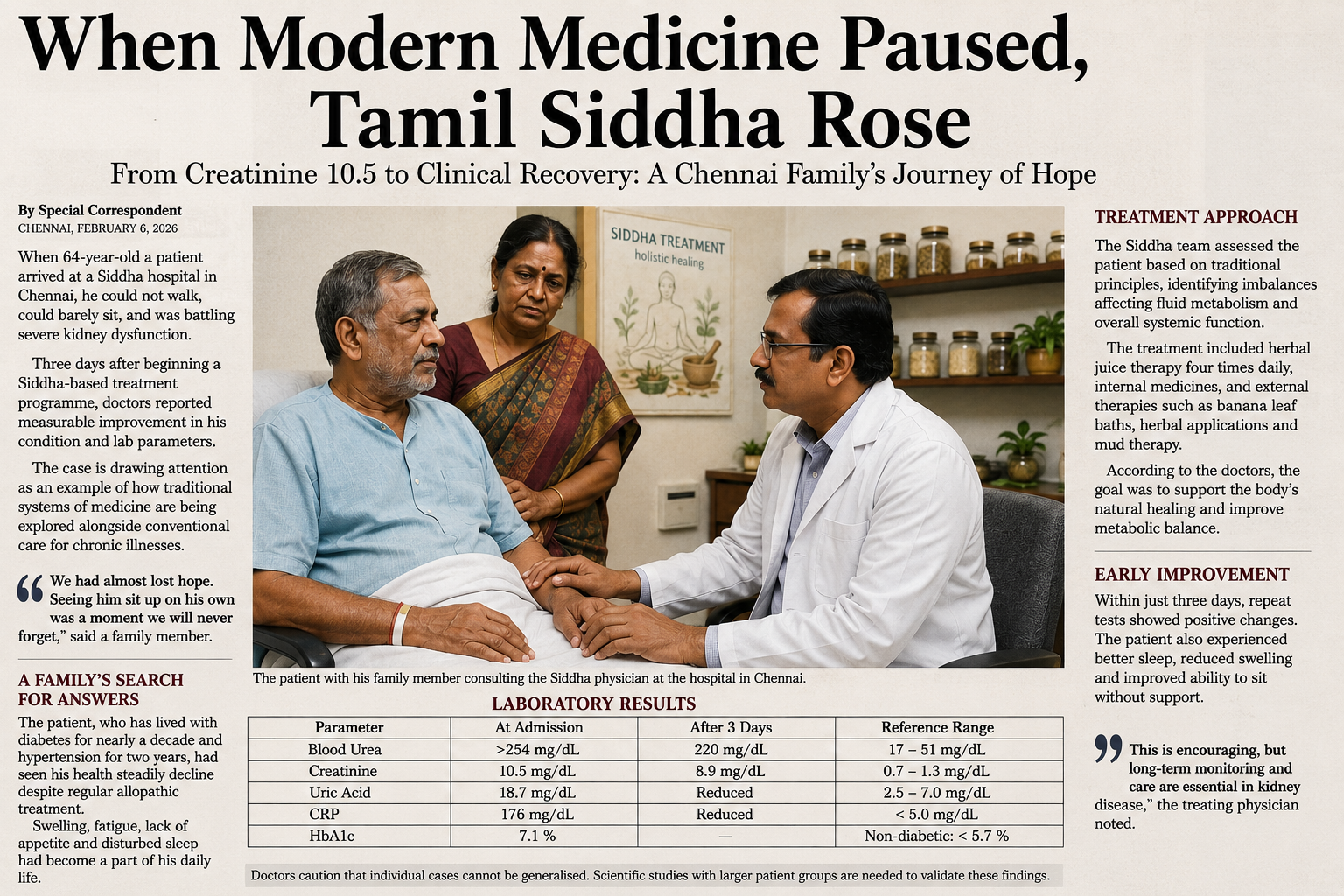
A 64-year-old patient undergoing Siddha-based supportive care at a Chennai treatment centre. Doctors reported measurable clinical improvement within days, while emphasizing that long-term kidney disease requires continued medical monitoring and further scientific evaluation.
By Dr. Pazhaniyappan BSMS,Special Health Correspondent
He did not arrive as a success story.
He arrived exhausted.
At 64 years of age, the retired family man could barely support his own weight. His legs were swollen. His face appeared puffy from fluid retention. Sleep had become fragmented, appetite had diminished, and even remaining seated required effort.
For years, he had lived with Type 2 diabetes and hypertension—two conditions that quietly increase the risk of progressive kidney damage. Despite ongoing treatment, his condition had deteriorated to the point where his family feared the worst.
What followed has become the subject of discussion among Siddha practitioners and patients seeking complementary approaches to chronic illness.
A Family Running Out of Options
The patient’s wife had watched his health decline month after month.
Each blood report seemed worse than the one before. Everyday activities became increasingly difficult. The man who once managed his household independently now required assistance for basic movement.
When the family eventually sought care at a Siddha hospital in Chennai, doctors encountered a patient showing signs of severe systemic illness.
The laboratory findings were striking.
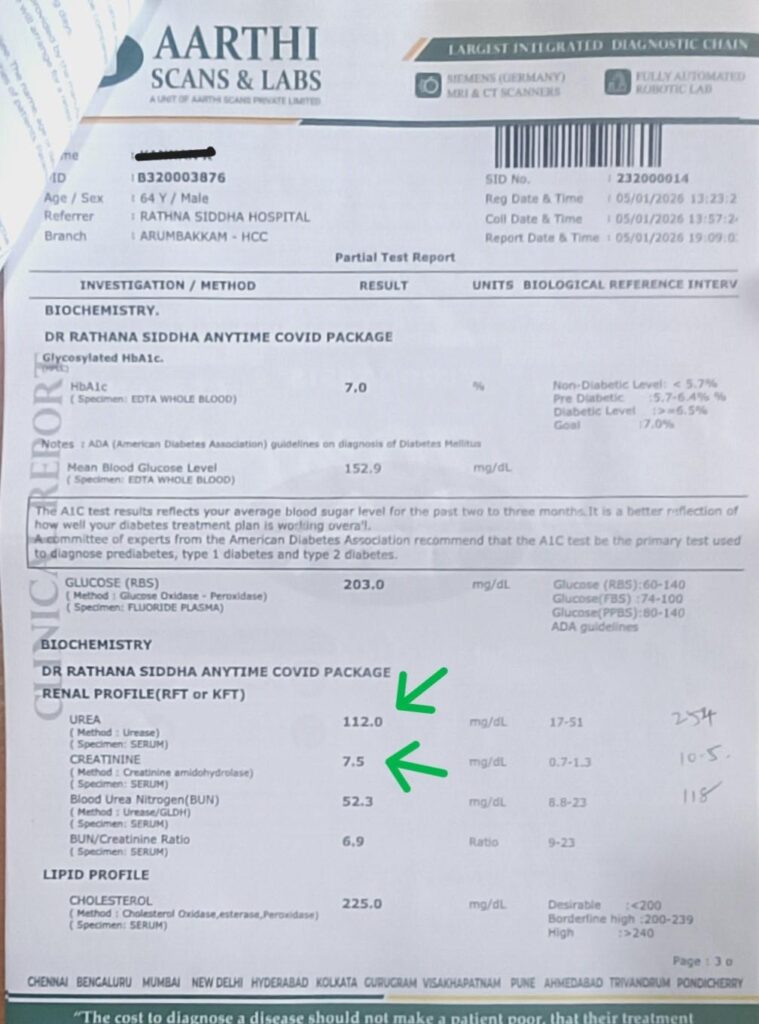
Admission Laboratory Findings
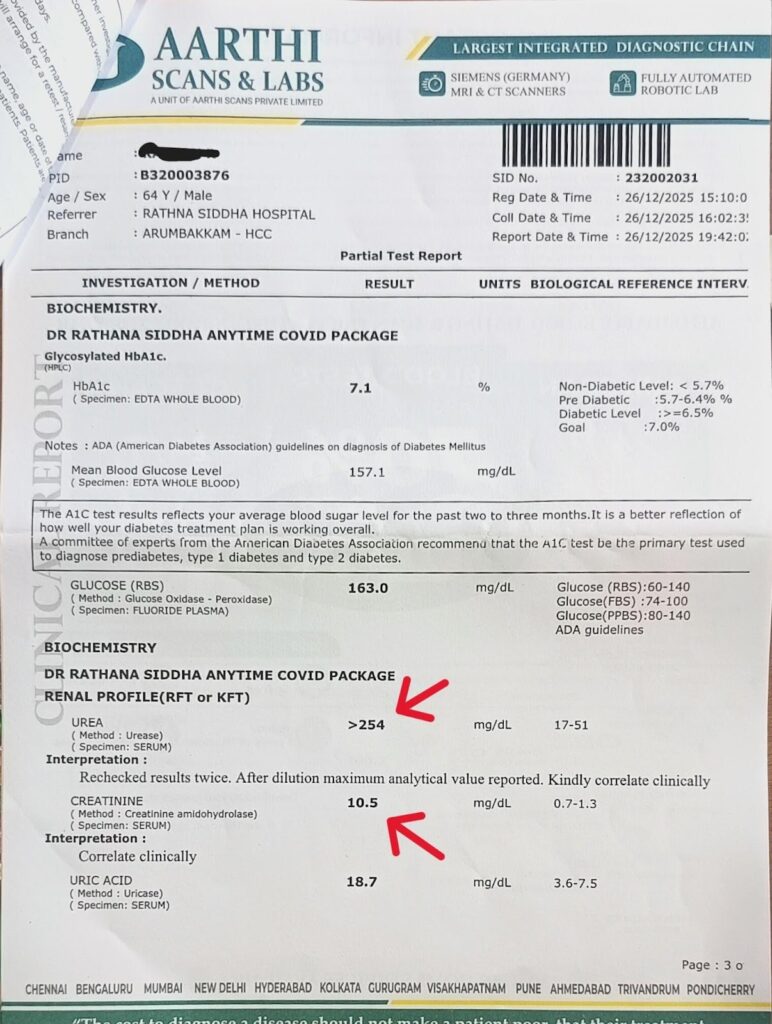
| Parameter | Result | Reference Range |
| Blood Urea | >254 mg/dL | 17–51 mg/dL |
| Creatinine | 10.5 mg/dL | 0.7–1.3 mg/dL |
| Uric Acid | 18.7 mg/dL | Normal laboratory range |
| CRP | 176 mg/dL | Indicates severe inflammation |
| HbA1c | 7.1% | Diabetic range |
To nephrologists, a creatinine value above 10 mg/dL signals serious impairment of kidney filtration function. The elevated inflammatory markers further suggested that the body was under considerable physiological stress.
A Different Medical Lens
Rather than focusing exclusively on laboratory values, the Siddha medical team assessed the patient through traditional Tamil medical principles.
Practitioners interpreted the illness as a profound disturbance in fluid metabolism, digestive function, and systemic balance. According to the treating team, the objective was not simply to reduce laboratory numbers but to improve the patient’s overall functional condition.
Treatment included internal herbal preparations, herbal juice therapy administered several times daily, dietary regulation, and external therapies traditionally used in Siddha practice.
Doctors describe the approach as supportive and restorative, aimed at reducing inflammation, improving metabolism, and helping the body regain physiological stability.
Early Changes Raise Interest
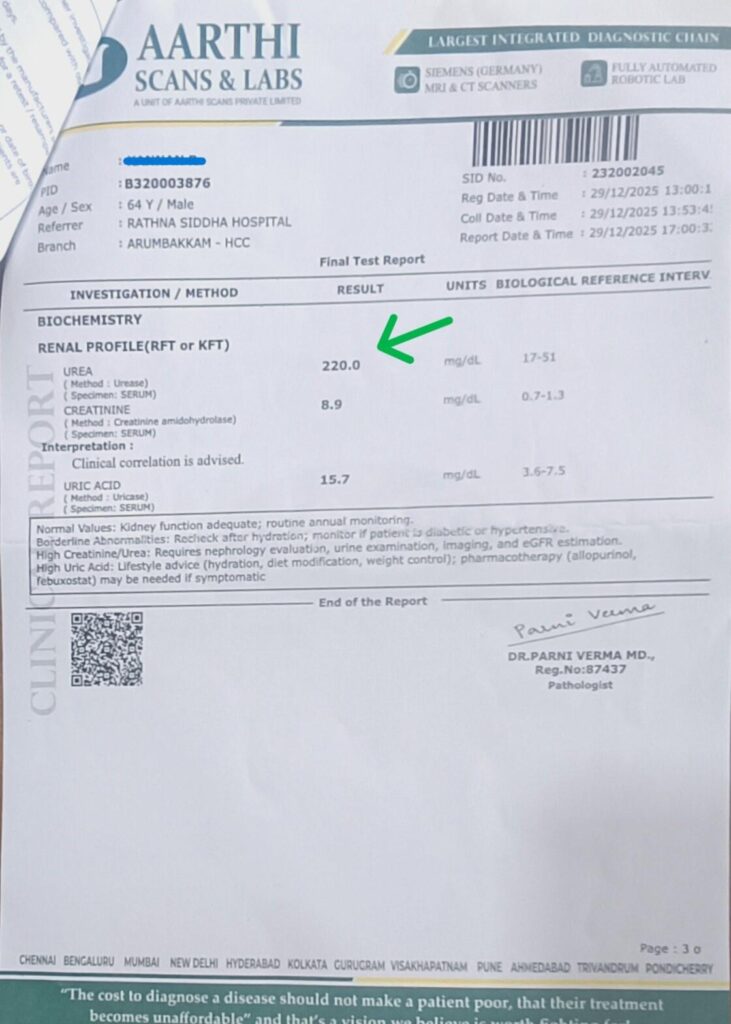
Three days after admission, repeat investigations showed measurable changes.
Laboratory Comparison
| Parameter | Admission | After 3 Days |
| Creatinine | 10.5 mg/dL | 8.9 mg/dL |
| Blood Urea | >254 mg/dL | 220 mg/dL |
| Uric Acid | Elevated | Reduced |
| Sleep Quality | Poor | Improved |
| Swelling | Significant | Reduced |
| Ability to Sit Upright | Required Assistance | Independent |
Doctors also reported improvements in thirst, urine output, and general comfort.
Most significant to the family was not the laboratory report but the visible change in the patient’s condition.
The man who had entered the facility unable to sit comfortably was reportedly able to remain upright without support.
“It was the first time in weeks that we felt something was changing,” a family member reportedly told caregivers.
The Larger Question
Cases like this sit at the intersection of two ongoing debates in Indian healthcare.
One concerns the growing burden of chronic kidney disease, diabetes, and hypertension. The other involves the role of traditional systems such as Siddha medicine in supportive and integrative care.
Medical experts caution that individual case reports, while valuable, do not establish treatment effectiveness. Scientific validation requires controlled clinical studies involving larger patient populations and long-term follow-up.
Nevertheless, clinicians acknowledge that carefully documented case observations often provide the starting point for future research.
For Siddha practitioners, the case represents an example of traditional medicine contributing to patient recovery and quality of life.
For researchers, it raises questions worthy of further investigation.
For one family in Chennai, however, the issue was never about proving a theory.
It was about seeing a loved one regain strength.
A Recovery Still Being Written
No responsible physician would describe advanced kidney disease as a condition that can be reversed overnight.
Yet the clinical improvements observed in this case—combined with visible changes in the patient’s comfort, mobility, and daily functioning—offer a reminder that healthcare is often measured not only through laboratory values but through human outcomes.
The story remains unfinished.
Long-term monitoring, continued treatment, and careful medical supervision will determine the patient’s future course.
But for a family that had nearly exhausted its optimism, the first signs of improvement were enough to transform fear into something they had not felt for months:
Hope.