
A Clinical Case Study From Rathana Siddha & Herbal Research Centre
Dr. Pazhaniyappan, BSMS
Published by Rathana Siddha & Herbal Research Centre
Key Takeaways
- Severe trauma affects not only bones, but also the nervous system, digestion, circulation, and inflammatory balance of the body.
- In Siddha medicine, post-traumatic complications are often interpreted as a major aggravation of Vatham, the governing force behind movement and neurological stability.
- A 20-year-old accident patient with femur fracture and neurological complications showed marked recovery within 25 days through an integrated Siddha rehabilitation protocol.
- Laboratory findings demonstrated major reductions in inflammatory stress markers including ESR, CRP, WBC count, and D-Dimer levels.
- The patient progressed from immobility and severe pain to functional mobility and systemic stabilization before discharge.
Why Severe Trauma Often Becomes More Than a Bone Injury
Road traffic accidents are usually treated as orthopedic emergencies. Immediate stabilization, fracture alignment, and surgical protection become the first priority. However, many patients continue to suffer long after the emergency phase ends. Persistent inflammation, neurological irritation, digestive suppression, sleep disturbance, and reduced mobility can delay meaningful recovery.
From the Siddha perspective, trauma is not viewed as an isolated structural injury. Instead, it is understood as a systemic disturbance affecting the body’s internal regulatory intelligence.
This case from Rathana Siddha & Herbal Research Centre highlights how an integrated Siddha protocol was used to support physiological recovery in a young patient experiencing severe post-traumatic complications after a road traffic accident.
Clinical Presentation: When Recovery Failed to Progress
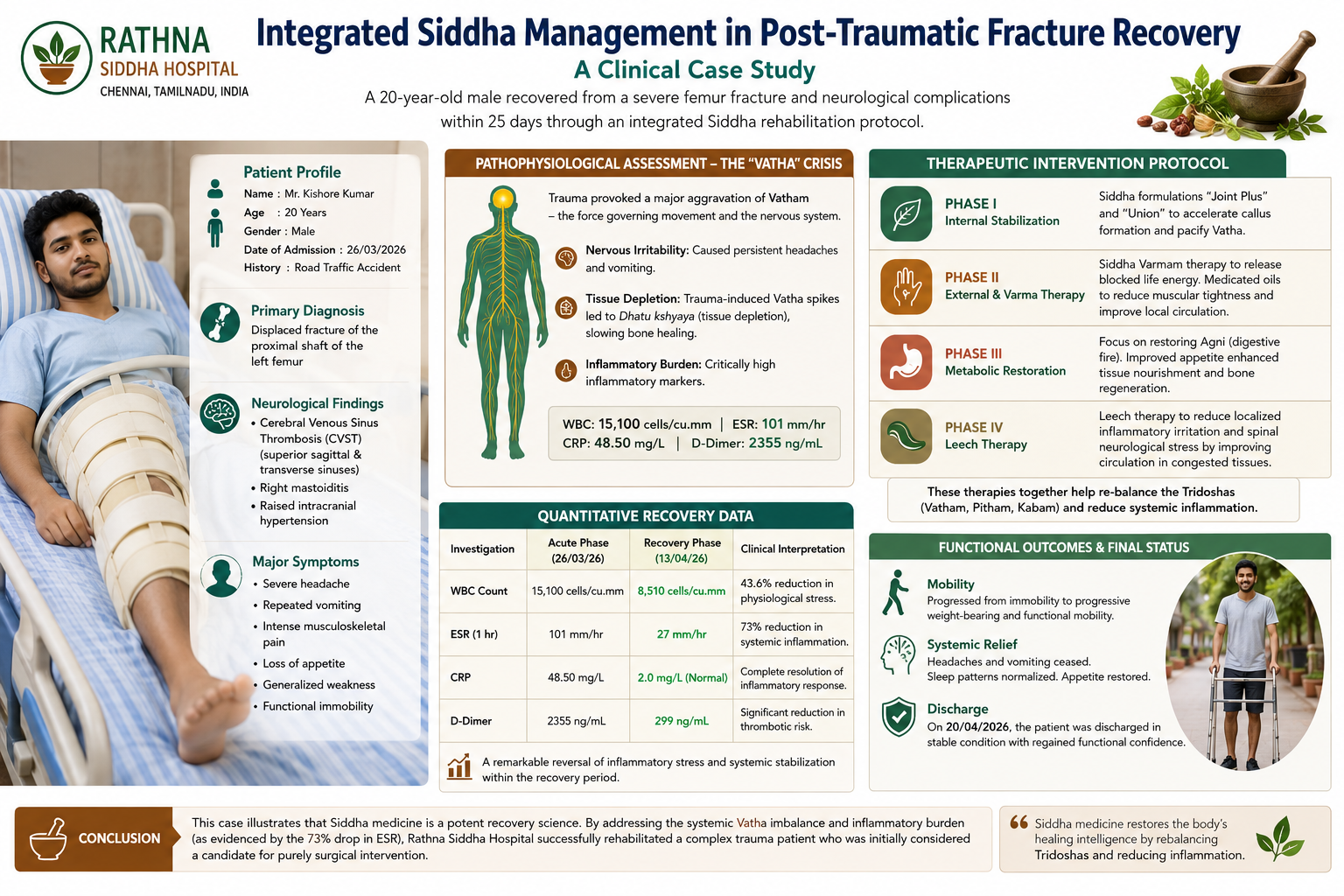
Mr. Kishore Kumar, a 20-year-old male, was admitted on March 26, 2026, nearly twenty days after sustaining injuries in a severe road traffic accident.
The primary diagnosis was a displaced fracture of the proximal shaft of the left femur. However, the complications extended beyond the fracture itself.
MRI and CT imaging revealed:
- Cerebral Venous Sinus Thrombosis (CVST)
- Superior sagittal and transverse sinus involvement
- Right mastoiditis
- Raised intracranial hypertension
By the time he arrived for Siddha management, the patient was experiencing:
- Persistent severe headache
- Repeated vomiting
- Intense musculoskeletal pain
- Loss of appetite
- Generalized weakness
- Functional immobility
Although emergency stabilization had already been performed, the patient continued to remain in a state of inflammatory and neurological distress.
Understanding the “Vatha Crisis” After Trauma
In Siddha medicine, traumatic injury is believed to provoke a major derangement of Vatham, the biological force responsible for movement, nerve coordination, circulation, and functional communication within the body.
When Vatham becomes severely disturbed after trauma, recovery may slow despite structural treatment.
In this patient, the Siddha assessment identified several interconnected patterns.
The first was neurological irritability. Persistent headaches and vomiting were interpreted as manifestations of disturbed Vatha affecting cranial circulation and nervous system balance.
The second was tissue depletion. Siddha literature describes trauma-induced metabolic exhaustion as a condition capable of weakening tissue regeneration and delaying fracture healing.
The third was systemic inflammatory overload.
This was strongly reflected in laboratory findings:
| Investigation | Acute Phase (26/03/26) | Recovery Phase (13/04/26) | Clinical Observation |
| WBC Count | 15,100 cells/cu.mm | 8,510 cells/cu.mm | Reduction in physiological stress |
| ESR (1 hr) | 101 mm/hr | 27 mm/hr | Major reduction in systemic inflammation |
| CRP | 48.50 mg/L | 2.0 mg/L | Inflammatory response normalized |
| D-Dimer | 2355 ng/mL | 299 ng/mL | Reduction in thrombotic stress |
The inflammatory burden suggested that the body remained in a prolonged stress response even after the acute injury phase.
Why Siddha Treatment Focused on Whole-Body Recovery
Rather than focusing only on the fracture site, the Siddha approach aimed to restore systemic balance.
According to Siddha principles, healing improves when digestion, circulation, nerve signaling, sleep, and tissue nourishment begin functioning in coordination again.
The treatment protocol at Rathana Siddha & Herbal Research Centre therefore followed multiple therapeutic phases.
Phase I: Internal Stabilization
The patient was administered Siddha formulations including Joint Plus and Union.
These medicines were selected to:
- Pacify aggravated Vatham
- Improve tissue nourishment
- Support callus formation
- Reduce internal inflammatory stress
- Enhance recovery capacity
In traditional Siddha and Ayurveda-based trauma care, such formulations are often considered strengthening agents for musculoskeletal and neurological recovery.
Phase II: External Therapy and Varmam Intervention
As pain and rigidity continued, Siddha Varmam therapy was introduced.
Varmam techniques are traditionally used to stimulate specific neuro-energetic points believed to regulate pain pathways, muscular coordination, and circulation.
The treatment focused on:
- Releasing muscular tightness
- Improving localized circulation
- Supporting nerve relaxation
- Enhancing mobility progression
Medicated external oil applications were also used to reduce stiffness and support functional movement.
Phase III: Digestive and Metabolic Restoration
One of the most significant clinical observations was the patient’s complete loss of appetite.
In Siddha science, digestive impairment is considered a major barrier to tissue healing because nourishment cannot effectively reach damaged structures when metabolic function weakens.
Treatment therefore emphasized restoration of digestive fire, or functional metabolic strength.
As appetite improved, the patient gradually demonstrated:
- Better sleep quality
- Improved energy levels
- Reduced vomiting
- Greater physical tolerance
- Progressive functional recovery
Phase IV: Leech Therapy and Circulatory Relief
Leech therapy was utilized as a specialized external intervention to reduce localized inflammatory congestion and neurological stress.
At Rathana Siddha & Herbal Research Centre, this procedure is used to improve tissue circulation and reduce stagnation associated with inflammatory overload.
From a Siddha perspective, improving circulatory balance assists the body in restoring its internal healing intelligence after trauma.
What the Recovery Data Revealed
One of the most striking aspects of this case was the measurable improvement in inflammatory markers within a short duration.
The ESR level reduced from 101 mm/hr to 27 mm/hr, representing nearly a 73% decline in systemic inflammatory burden.
CRP levels normalized completely.
D-Dimer values also showed major improvement, suggesting reduction in thrombotic stress and circulatory strain.
Clinically, these changes paralleled the patient’s visible functional recovery.
From Immobility to Functional Confidence
By the third week of treatment, the patient’s condition had shifted significantly.
The persistent headaches and vomiting subsided completely. Sleep patterns normalized. Appetite returned gradually, followed by improvement in strength and tolerance.
Most importantly, the patient progressed from immobility toward progressive weight-bearing and functional movement.
On April 20, 2026, the patient was discharged in stable condition with regained functional confidence and improved systemic stability.
What This Case Suggests About Siddha Rehabilitation
This case illustrates an important principle frequently emphasized in Siddha medicine: recovery from trauma depends not only on structural repair, but also on restoration of systemic physiological balance.
The reduction in inflammatory markers, neurological symptoms, digestive suppression, and mobility restriction suggests that integrated Siddha management may play a meaningful role in post-traumatic rehabilitation support.
While surgical stabilization remains essential in many orthopedic emergencies, this case demonstrates how Siddha medicine may contribute to the recovery phase by addressing inflammation, circulation, metabolic exhaustion, and Vatha imbalance simultaneously.
For patients experiencing prolonged inflammatory stress after trauma, whole-body rehabilitation approaches may offer additional clinical value alongside conventional orthopedic management.
References
- Siddha Medicine and trauma rehabilitation literature from the Journal of Ayurveda and Integrative Medicine.
- Natarajan S, et al. Treatment of acute avulsion of posterior cruciate ligament with Siddha Varmam therapy and traditional bone setting method. Journal of Ayurveda and Integrative Medicine. 2019.
- Raghavi M, Gopalakrishna G. Role of Ayurveda in rehabilitation of traumatic neurological disorders. Journal of Ayurveda and Integrative Medicine Sciences. 2023.
- Sindhuja BS, Sankar I, Tiwari S. Siddha rehabilitation approaches in foot drop management. Journal of Neurology and Neurosurgery. 2025.
- Baikampady SV. Vata dynamics and systemic disorders: A cross-disciplinary approach. Journal of Ayurveda and Integrative Medicine. 2020.