
He did not walk into the hospital.
He was carried to Rathna siddha hospital, Chennai.
At 64, Mr. Kannan’s body had grown too weak to support him. His legs were swollen. His face was puffy. His appetite had disappeared. Sleep came in fragments. Even sitting upright required effort.
He was not a smoker.
He was not a drinker.
That is why, his wife refused to give up on him. She stood beside him through every report, every injection, every restless night. She believed that a man who had lived with discipline deserved extraordinary care.
Thus,
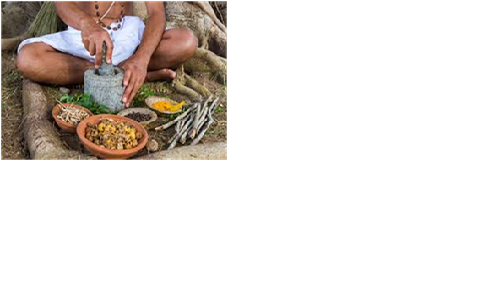
she reached to siddharthiruthanikasalam, who is well known for his “TamilTraditional HerbalTreatment.
Background
Mr. Kannan had a known history of Type 2 Diabetes Mellitus for 10 years and Hypertension for 2 years. Despite regular allopathic medication, his condition progressively worsened, resulting in severe functional limitation. When he arrived at the Siddha hospital, he required wheelchair assistance and appeared clinically debilitated.
Blood Laboratory Crisis
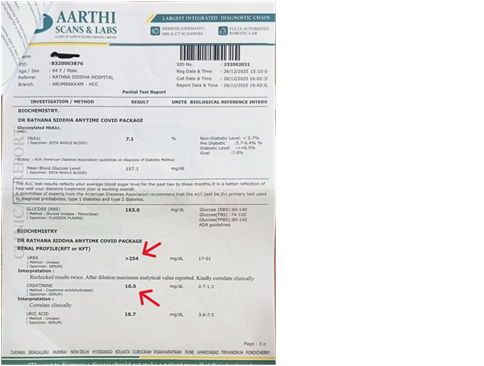
The patient was advised to go for a blood laboratory test. The parameters reflected critical renal compromiselike:
Urea: >254 mg/dL (Normal: 17–51)
Creatinine: 10.5 mg/dL (Normal: 0.7–1.3)
Uric Acid: 18.7 mg/dL
CRP: 176 mg/dL (Severe systemic inflammation)
HbA1c: 7.1% (Diabetic range)
Such elevated creatinine and urea levels indicate severe impairment in renal filtration capacity. The markedly elevated CRP suggested an intense inflammatory state, placing the patient in a high-risk physiological condition.
Siddha Doctors team Assessment
The treatment of the Patient, did not begin with machines. It began with listening — to the pulse, to the breath, to the silent exhaustion written across his face.
The Siddha physician did not see failing kidneys alone; he saw a body overwhelmed and imbalanced. According to Tamil Siddha principles, prolonged metabolic disturbance had deranged NeerThathu (fluid metabolism), weakened digestive fire, and aggravated Vatham and Iyyam. The aim was not merely to reduce numbers on a laboratory sheet, but to restore systemic harmony.
The siddha doctors team examined the laboratory report. Identified Vatha–Kapha aggravation. They termed it with Neerizhivu, Madumegam, and Rattthakothippu.
Siddha and Ayurveda Therapy begins
Herbal juice therapy was administered four times daily, carefully designed to regulate fluid balance and gently assist detoxification.
Internal Medicines included:
– Herbal juice therapy (200 mL, four times daily)
– Herbal liquid preparation for metabolic correction
– Powder formulations for Vatha pacification and vitality
Classical Siddha formulations were selected to pacify aggravated humors, support renal channels, and strengthen metabolic resilience. Detox protocols were initiated to reduce the long-term burden of synthetic medications and revive digestive strength.
External Therapies included:
– Banana Leaf Bath (VaazhaiIlaiSnaanai) for thermoregulation and detoxification
– MeethiSigichai using neem and bitter gourd leaves to reduce inflammatory swelling
– Mud therapy on alternate days for systemic cooling and edema reduction
Throughout every session, his wife stood beside him. The room carried the scent of herbs — and unwavering commitment.
Early Measurable Outcomes (3 Days)
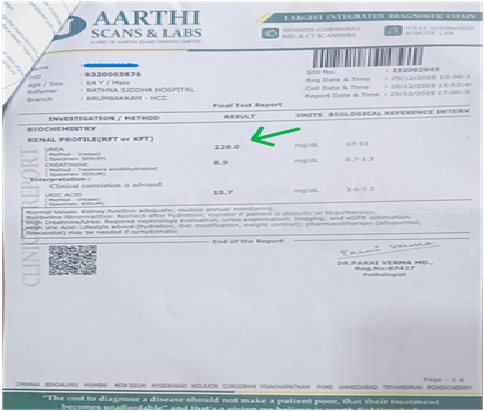
Three days later, the laboratory sheet no longer looked identical.
Creatinine reduced from 10.5 mg/dL to 8.9 mg/dL.
Urea dropped from more than 254 mg/dL to 220 mg/dL.
Uric acid levels declined significantly.
These were not symbolic improvements. They represented physiological response.
Clinically, thirst reduced. Sleep improved. Urine output stabilized. Swelling slightly subsided. The man who had been carried into the hospital was now able to sit upright without support.
His eyes were clearer. His voice steadier.
Hope, once fragile, began to gain structure.
Conclusion
Chronic kidney disease does not reverse overnight. Responsible medicine does not casually use the word miracle.
Yet when a man enters a hospital unable to walk, with creatinine at 10.5 mg/dL and severe systemic inflammation, and within days shows measurable improvement and restored vitality, something meaningful has occurred.
For his wife, it was not about scientific debate.
It was about seeing her husband sit upright again.
For the Siddha physician, it was about restoring balance where collapse had begun.
When modern medicine paused, Tamil Siddha rose — not as opposition, but as intervention.
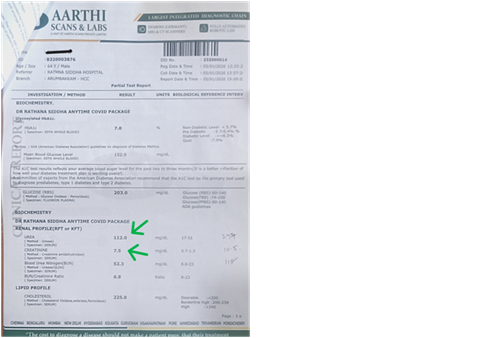
And in that quiet intervention, life began to steady itself once more.
Use prompt for other case study
“Transform this case into a cinematic yet academically responsible Siddha feature article with emotional storytelling, measurable outcomes, and strong Tamil traditional medicine emphasis.”
Start with cinematic storytelling.
Give more importance to Siddha and Tamil traditional medicine.
Include scientific explanation but keep it simple.
Show measurable lab improvements.
End with a powerful emotional conclusion.
Maintain professional tone.